




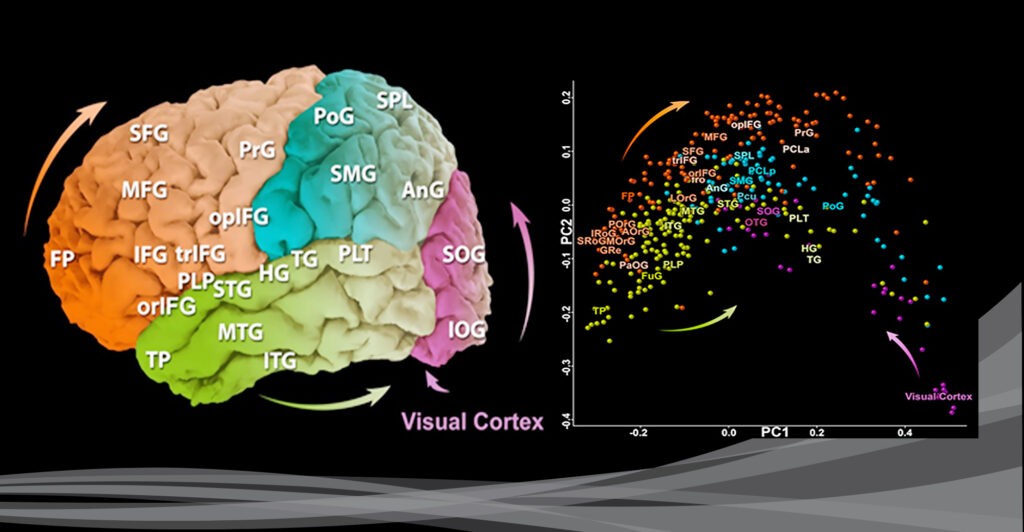
¿Qué es el Mapeo Cerebral?
El mapeo cerebral es un conjunto de técnicas de la neurociencia dedicadas a la cartografía de las cantidades o propiedades (biológicas) en las representaciones espaciales del cerebro (humano o no humano) resultante en mapas. El mapeo cerebral se define además como el estudio de la anatomía y funcionamiento del cerebro y la médula espinal a través del uso de imágenes, inmunohistoquímica, la optogenética, células madre, la biología celular, la ingeniería (material, eléctrica y biomédica), la neurofisiología y la nanotecnología.
Toda neuroimagen puede ser considerada como parte del mapeo cerebral. El mapeo cerebral puede ser concebido como una forma superior de neuroimagen, como la producción de imágenes cerebrales complementadas por el resultado adicional de procesamiento de datos o análisis, tales como los mapas proyectantes de las regiones del cerebro. Uno de estos mapas, llamado conectograma, representa regiones corticales alrededor de un círculo, organizada por lóbulos. Círculos concéntricos dentro del anillo representan diversas mediciones neurológicas comunes, como el grosor cortical o la curvatura. En el centro de los círculos, líneas que representan a las fibras de la materia blanca ilustran las conexiones entre las regiones corticales, ponderados por la anisotropía fraccional y la fuerza de conexión.1
Las técnicas de mapeo cerebral están en constante evolución, estas se basan en el desarrollo y perfeccionamiento de las técnicas de adquisición de imágenes, de representación, análisis, visualización y técnicas de interpretación. La neuroimagen funcional y estructural son el aspecto central del mapeo dentro del mapeo cerebral.
REFERENCIAS:
- Irimia, Andrei; Chambers, Micah C.; Torgerson, Carinna M.; Horn, John D. (2012). «Circular representation of human cortical networks for subject and population-level connectomic visualization». NeuroImage 60 (2): 1340-51. PMC 3594415. PMID 22305988. doi:10.1016/j.neuroimage.2012.01.107.
- ↑ Pechura, Constance M.; Martin, Joseph B. (1991). Mapping the Brain and Its Functions: Integrating Enabling Technologies Into Neuroscience Research. Institute of Medicine (U.S.). Committee on a National Neural Circuitry Database.[página requerida]
- ↑ Koslow, Stephen H.; Huerta, Michael F. (1997). Neuroinformatics: An Overview of the Human Brain Project.[página requerida]
- ↑ Van Horn, John Darrell; Irimia, Andrei; Torgerson, Carinna M.; Chambers, Micah C.; Kikinis, Ron; Toga, Arthur W. (2012). «Mapping Connectivity Damage in the Case of Phineas Gage». En Sporns, Olaf, ed. PLoS ONE 7 (5): e37454. PMC 3353935. PMID 22616011. doi:10.1371/journal.pone.0037454.
- ↑ Irimia, Andrei; Chambers, Micah C.; Torgerson, Carinna M.; Filippou, Maria; Hovda, David A.; Alger, Jeffry R.; Gerig, Guido; Toga, Arthur W.; Vespa, Paul M.; Kikinis, Ron; Van Horn, John D. (2012). «Patient-Tailored Connectomics Visualization for the Assessment of White Matter Atrophy in Traumatic Brain Injury». Frontiers in Neurology 3. PMC 3275792. PMID 22363313. doi:10.3389/fneur.2012.00010.
- ↑ Toga, Arthur W.; Mazziotta, John C., eds. (2002). Brain Mapping: The Methods. ISBN 978-0-12-693019-1.[página requerida]
- ↑ http://www.ncbi.nlm.nih.gov/pmc/articles/PMC3171915/
- ↑ Harvard Whole Brain Atlas
- ↑ Serag, Ahmed; Aljabar, Paul; Ball, Gareth; Counsell, Serena J.; Boardman, James P.; Rutherford, Mary A.; Edwards, A. David; Hajnal, Joseph V. et al. (2012). «Construction of a consistent high-definition spatio-temporal atlas of the developing brain using adaptive kernel regression». NeuroImage 59 (3): 2255-65. PMID 21985910. doi:10.1016/j.neuroimage.2011.09.062.